More 3D Comin’ at Ya!
Is She Amused?
3D glasses were available at select Canada Post outlets (as listed in the PDF file) but supplies may have run out by this point. The glasses were gone by Monday at my local outlet, so the initial review of the show will likely reflect the doc’s content rather than 3D effects.
First caveat: the Queen doc uses the ColorCode 3D system which isn’t compatible with the old red-blue glasses some of you may have lying around. ColorCode uses blue-amber filters, so you’ll need glasses that have blue for the right eyeball, and amber for the left; anything else will cause your brain to convulse, porridge to emerge from your nose, and strange blinky-blinky lights to glow from the tips of your pinkies.
Second caveat: the CBC doc is actually an edited-down version of the original 2-part (!) series that ran last November on England’s Channel 4, as part of their own 3D special series. Each part runs under 48 mins., whereas the CBC edit is far less, and includes the interpolation of news and thespian figures from the corp’s talent pool. I’ll have reviews of both the original 2-part and CBC versions early next week, since the handling of the content is a bit different.
Third Caveat: both docs apparently aren’t contrived reprocessed 3D footage from 2D sources. The docs contain a mix of newly shot 3D footage of the Queen’s recent trip to Canada, and (amazingly) newly discovered 3D film of her coronation back in 1953. The CBC’s efforts to air their doc began with on-air tests to see if the 3D system could be implemented nationally, and actually work, as this August 11th blurb briefly explains.
I’m indifferent to the Queen, the Monarchy is outdated, but hey, it’s a test to see how well the format on the Idiot Box performs as networks test 3D material while more 3D content is slooooowly making its way to 3D Blu-ray so your $4000 setup is put to actual three-dimensional use.
Future Shop is selling various combo packages with player + set + glasses + transmitter, and more 3D BR titles were announced last week that everyone can buy, as opposed to the exclusive one title-per specific manufacturer deal that may be the dumbest ploy to convince you and me to buy yet another new TV.
Avatar, for example, will be available as a 3D BR title Dec. 1st, but only if you buy the Panasonic gear. Other exclusive deals with no end-date for the rest of consumer society include Alice in Wonderland 3D exclusive to Sony 3D sets; and Monsters vs. Aliens 3D, all four Shrek films in 3D, and How to Train Your Dragon 3D exclusive to Samsung buyers.
If this scheme was initially applied to the first year of Blu-ray’s existence, the format would’ve died within a year. The industry’s short-term memory tends to forget historical boo-boos from which it could learn a great deal.
In any event, I’ll have more thoughts on the CBC and Channel 4 docs, and the fascinating backstory of how Queen Elizabeth II happened to be filmed in 3D. It’s pretty amazing this stuff sat forgotten for 50+ years, and I frankly hope the current 3D resurgence will cause other rarities to be dusted off, restored, properly preserved, and commercially released, because headaches and seeing misaligned colours are part of our collective anaglyph photograph and cinema history, right?
Seriously. Porridge from the nostrils like you wouldn’t believe.
Mark R. Hasan, Editor
KQEK.com
Werner Herzog in 3D
Probably the next best thing to attending a lecture headed by Werner Herzog (or his Rogue Film School) is seeing a documentary of the eccentric filmmaker in 3D, where you can reach out and pat his crazy little head with affection for making a movie every three months (or thereabouts) on all kinds of unusual subjects.The latest 3D news isn’t that Martin Scorsese will make Hugo Cabret in 3D (he will, this fall, and further details are at hitflix.com), but that Herzog will shoot a documentary on cave paintings in the format (as reported at Movieline.com).
What’s not amusing (and rather straightforward) is his decision to capture ancient paintings in a 3D process because light and exhalations from visitors over time will destroy the art that’s been tucked away in hidden caves for eons. If the Discovery Channel can shoot sharks in 3D, and Jimmy Cameron can film his beloved Titanic wreck in 3D, then there’s nothing outrageous about inaccessible cave paintings in the third dimension.
It’s Herzog, however, which means the results will be intriguing, his voice in the narration soothing, and the behind-the-scenes footage will capture the crazy man as he and two other production technicians wiggle their way into tiny caves. David Attenborough may be the King Host of nature documentaries, but Herzog is the König of everything odd and unusual.
Speaking of 3D, with Clash of the Titans now out for a few weeks, a few articles have appeared with unsubtle warnings about the ill-affects of hasty conversion processes (see Gizmodo.com + Slate.com for separate articles). The collective fear is that poor conversions and weak films will kill the format as happened in the 80s, but in fairness, few of the 3D films of that era were any good.
Most were gimmicky horror, animated or sci-fi films, done cheaply, and with little purpose beyond shoving something in your face. The 50s had greater variety, from westerns to musicals, thrillers like the much vaunted (and deservedly so) House of Wax to alien attacks, but the format’s mothballing probably stemmed from the imperfect anaglyph process (goofy glasses, headaches for some), insufficiently widespread implementation and distribution of 3D films throughout the market. (The push was fast, but perfectly fine films like Kiss Me Kate were mostly shown flat as the format’s success waned).
Moreover, if given a choice in 1953, people seemed to prefer super wide films in Cinerama and CinemaScope than 1.33:1 films where you had to wear itchy cardboard glasses. So Herzog and Scorsese jumping into 3D is a good thing, because it means they’ll add more dramatic variety to 3D processes that may well have longevity, since digital systems are in play, and the first generation of 3D TV sets are supposed to handle Blu-ray and cable TV 3D offerings – a big difference from the fifties where TVs at best offered colour; and the eighties, where anaglyph 3D fodder was peddled out via the odd 3D TV broadcast (Hondo, Gorilla at Large, The Mad Magician), VHS tapes (The Mask), and VHD, the obsolete Japanese videodisc format that offered backwards compatible 3D films, using LCD shutter glasses for films like Jaws 3D, Amityville 3-D, and Dial M for Murder.
Hopefully 20 years from now someone isn’t citing in his/her blog the antique gear used in the format’s third wave (which now extends to, uh, 3D laptops?) as a fourth in underway. Maybe in 2030 we’ll actually be living Hitchcock’s 3D dreamland, sitting in a chair that’s in the room, tucked in the corner of a cave, or the back seat of a car being projected in a home-styled 3D room where satellite video and audio signals immerse the viewer in actual scenes.
And maybe, just maybe, the gear will have Herzog seated a few feet from you, schlucking a marillen schnapps as he recalls that 'insignificant' moment when he thought about killing Kinski.
Best use of 3D I can think of.
Mark R. Hasan, Editor
KQEK.com
When the pick-axe falls far from the mark
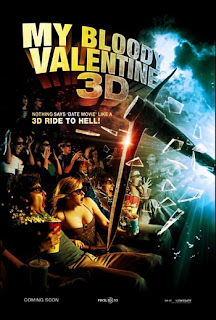
Patrick Lussier’s My Bloody Valentine should give a reason for all those writers to pause and rethink rebooting/remaking/re-imagining perfectly fine originals and perhaps motivate them to just make their own slasher classic, but there’s something about a brand name that makes a remake more likely to enjoy a green light from the studio than a wholly new idea or derivation.There’s also the home video aspect where the production studio probably owns the original film (or at least the current video rights), so there’s that tie-in factor using the new film to sell copies of the old on DVD, and the new film on DVD to create interest in the next 3D or similar genre production.
It’s totally natural from a business stance to exploit your most recognizable assets, but when there’s a weak script at the core, it's foolish to rely on special effects and gimmicks to keep viewers glued to the screen.
Lionsgate’s DVD includes both flat and 3D versions of My Bloody Valentine (with 4 pairs of 3D glasses), as well as a second disc of featurettes and deleted material, and while it's a good package, there’s still the issue of the film, which is addressed in the DVD review.
Note: the 3D version is on the B-side of Disc 1 in Maple’s Canadian release, and the Blu-ray edition does not include a standard DVD version of the film – that’s a misprint on the front sticker that’ll be clarified in the next pressing. The movies and extras, though, are fine.
- MRH
The Endurance of IMAX
Under the Sea 3D is the latest co-venture between IMAX and Warner Bros., and furthers director Howard Hall and editor/producer Toni Myers’ ongoing interest in filming exotic and endangered pockets of the world in the internationally renowned large film format.I’ll have a film review of Under the Sea as well as its predecessor, Deep Sea 3D (2006) uploaded shortly, but in the meantime here's an interview with Toni Myers, who discusses aspects of the film, as well as the first IMAX movie, North of Superior (1971), which is still beloved by several generations of school kids, particularly aging grammar school brats (like myself) who were taken on class trips to the Cinesphere at Ontario Place, and had no idea what the heck was in store.
The opening credit sequence is still one of the most memorable film-going experiences of my childhood, with the canted camera gliding and swooping all over classic Ontario terrain. I do get seasick and motion sickness and can’t deal with an IMAX camera strapped to the head of a rollercoaster or snowmobile, but I still yearn to re-experience the film because it’s been probably 25-30 years since I saw it.
Myers also directed Blue Planet (1990), one of the best space-themed IMAX films, and perhaps her most overt statement on environmental changes that are wreaking serious damage on the earth. The film’s tone is straightforward, and it’s supported by large, elegant footage of the Earth as shot from space shuttle missions, capturing massive forest fires, deforestation, and other trauma visible from the shuttle windows.
The reason that film also stands out is because of the elegant music score by Maribeth Solomon and Micky Erbe (see archived interview HERE) and one simple shot – the blackness of space, and the Earth rising from the depths of the IMAX screen until it fills the multi-storey panorama, with you feeling like you’re hovering in space and descending slowly to the Earth on some big glass spaceship.
It’s adventurism and edification (learning a bit about the planet’s uniqueness) on film, and a sublime movie moment. It’s also a sample of Myers’ heavy experience in directing, cutting, and producing a movie in 70mm – a film format that may one day be overtaken by digital technology.
Soon after catching an advance screening of Under the Sea, I also caught The Dark Knight (2008) in IMAX, and it was memorable experience in part because director Christopher Nolan proved you could make a kinetic feature-length film in IMAX. The movie was primarily shot in standard 35mm, and contains a few sequences and shots in IMAX, but there were very little differences in the editing styles of the IMAX and 35mm footage.
The formal thinking is that IMAX is too big, and the aggressive editing style of standard 35mm is too overwhelming for audiences – and that may be true for a substantial chunk of moviegoers – but that’s also been a complaint levied against certain films shot in standard 35mm (1.85:1 or 2.35:1) where the directors went bonkers with cuts and gave audiences some massive headaches.
Nolan’s own Batman Begins (2005) has clumsily staged action scenes, with the camera too close to the actors and their motions, and edits deliberately designed to disorient; Paul Greengrass’ The Bourne Supremacy (2004) has chase sequences with cuts and camera setups that go beyond frenetic and fuzzy, and literally waste the fancy locations used to stage the action scenes; and Michael Bay’s The Rock (1996) is still a fine example of ego and excess, and where every actor's movement is seemingly captured from 45 different camera angles and edits.
Even Tony Scott showed signs of losing his mind when, early into Spy Game (2001), Robert Redford’s entrance into his office was covered by multiple cuts of variable angles – a totally blah character movement with zero thematic undercurrent constructed to resemble something seriously imperative when it seriously wasn’t.
And yet that indulgent editing style has become more refined and acceptable, and that’s perhaps due to our own visual evolution; we got used to the fast visuals over time, and we’re better able to assemble meaning from what was previously just a mass of visual clutter.
Astute directors know how to be more selective (which is why The Rock will always be an unintentionally campy goof-fest, and the tongue-in-cheek Crank will remain deliberately campy fun), and that’s evident in Nolan’s own evolution as a filmmaker: his action sequences are better staged in Dark Knight, and the edits more selective, and to compensate for a less crazy editing style, he uses a dense aural mix that slams audiences where a mass of cuts and blurry footage were applied.
The integration of IMAX (1.44:1) within Dark Knight’s 2.35:1 framework is also notable because it’s not in your face: IMAX pops up in establishing shots (Bruce Wayne in Hong Kong), as movement motifs (Bruce driving his fancy schmancy Lamborghini), and as portions of stellar action sequences.
You could call it as gimmicky as donning 3D glasses for select sequences (like Bryan Singer’s Superman Returns) but then the gimmick is used well – and it opens the door to whether IMAX has a future in a technological hybrid like Dark Knight, or for the entirety of a feature-length film.
It’s been done before: the original theatrical version of Titanica (1995) ran over 90 mins. (the DVD features an edited version), but it was screened with an intermission to give audiences pause - a ploy also used for House of Wax, back in 1953 by Warner Bros., because the feeling was that a feature-length 3D film would be too hard on audiences. (In anaglyph, sure, but IMAX 3D, maybe not, since the gray glasses aren’t as headache-inducing as the old red-blue ones from the fifties and eighties.)
So whether Nolan’s clever hybrid will be followed by another, if not a feature-length action film in IMAX is the big quandary. As Toni Myers opines in our interview, 70mm film is expensive, and whether it’s a three or two hour film, that’s a lot of money on such a big acquisition and distribution format.
Dark Knight was a financial and critical blockbuster, and it may well be a rare one-off if digital exceeds the creative latitude inherent to 35mm film, but whenever Nolan cuts to an IMAX shot, the image clarity and richness of colours are noticeably substantial – and that alone may ensure IMAX’ stature for a while longer.
- MRH