0

It All Boils Down to Cabbage

The BBC World News reports that a High Court in London has decided in favour of the band Pink Floyd, supposedly preventing giant EMI from breaking up what the band calls concept albums into separate songs and selling them individually as digital downloads in services like iTunes.

EMI’s been ordered to pay $60,000 U.S. in costs, but the victory seems soft in light of further issues that still have to be argued and resolved in court, including the original contractual wording which Pink Floyd argues ensures the albums must remain intact when commercially released in any form. To “preserve the artistic integrity of the albums” is what helped keep albums like Dark Side of the Moon from being fully chopped up and released as singles, but EMI still argues the contract only applies to vinyl.

The case somewhat echoes an old clause in Orson Welles’ contract with RKO that prevented anyone from re-editing or altering Citizen Kane (1941) in any form without the permission of Welles or his estate, which protected the film when rumours of it being colorized surfaced during the eighties.

To one end of the Pink Floyd case, there’s the artist not being paid or paid sufficiently when a distribution contract is read as covering current and future media and distribution venues; to the other, there’s films or TV series, for example, not being released in one format because a label says the original monies paid to allow the inclusion of a song didn’t include future formats like DVD or any other digital format, making the home video release of something like WKRP in Cincinnati impossible for years.

Season 1 did eventually materialize after negotiations and replacement songs were sorted out, but the show’s yet to receive a second season release, either because it sold poorly, or negotiations are still ongoing. It’s due likely to poor sales in the eyes of label Fox, and the fact the years of contractual arguing prevented the show from emerging on DVD when interest was at its peak.

Labels are notorious poor in badly gauging the maximum interest level among mid-level fans just before it crests and starts to wane. Ardent fans will continue to pressure the release of a work, but so much TV product is out there – old and new series – that people will forget. Remember: while someone may want the release of a full season, in the case of an hour-long series from the eighties, that may be 22 or 24 episodes to plow through, which makes for considerable viewing time instead of a 100 min. movie that’s been unavailable for decades.

Watching Antonioni’s The Passenger (1975) – long gone from home video until Sony’s 2006 DVD - takes up around 2 hours of viewing time, but even a half-hour show like WKRP is more than 9 hours, a time-hog that also has to compete with what’s currently on network and cable TV, as well as what you missed and plan to catch-up on DVD, like Mad Men or the full run of The Sopranos that you never managed to watch.

Certainly in the case of TV, studios and networks have to get the show out while the interest remains within the broadest viewer base, because unlike vintage shows Father Knows Best, The Untouchables, The Twilight Zone, Hawaii Five-0, The Mary Tyler Moore Show, or M*A*S*H, more recent series use popular music for montages, or to make the shows feel fresh and of-the-minute, and that eighties cliché has hindered the release of series like WKRP due to music rights issues.

This digression into film and TV merely shows how convoluted things can become when a song or an album becomes a commodity that labels want to exploit, artists want to protect, and technology mucks things up with new venues that cause both sides to seek a clear interpretation of a contract.

Anyone familiar with Pink Floyd knows their albums are conceptual works, and while songs from The Wall did appear as singles, Dark Side of the Moon is essentially one long work with tracks cross-mixed to form interconnected movements; with the exception of the song “Money,” chopping up the rest would have songs missing their opening and closing bars without a new remix.

According to the BBC report, EMI’s position is that the High Court’s ruling doesn’t force the label from making Floyd’s albums available as single track downloads, but perhaps the ruling will bring forth other artists, and the issue will progress further through the courts and eventually let artists have a say in the way their works are disseminated.

EMI’s just posturing for the media; there’s offering choice for the consumer, and then there’s hacking up a work that was edited and mixed as a full listening experience.

And completely unrelated, but also reported by the Beeb, is an announcement that the Royal Opera House’s plan to mount the Anna Nicole Opera is a go.

No, this is real.

I’m waiting for something of substance, like Cabbage: An Oratorio in Three Movements - “Seeding of Soil,” “Rounder is Better,” and the epic conclusion “Roughage,” with the audience cradling fiery votive cabbage rolls.

Wouldn't that be the event of a lifetime?


- MRH
0

Oscar Night Wrap-Up

The 82nd Oscars ended Sunday night at a few minutes after midnight, clocking in at around 3.5 hours, and undoubtedly media writers will be playing up Katherine Bigelow's historical new position as the first woman to win an Oscar for Direction. (I won't, but maybe there's some symbolic goodness in that her win on Sunday preceded International Women's Day, the following Monday.)

Much like Mo'Nique's winning Best Supporting Actress for Precious, when a performance or film is that good, race or gender or persuasion makes no difference. Of course, an Oscar win is also a mishmash of what's deserved as well as who deserves it based on other criteria. It certainly helped that Best Actor Jeff Bridges is a veteran with an excellent body of work (Fabulous Baker Boys is still one of maybe 5 films I'd want to have with me if stranded on an island, plus, uhm, a solar powered portable DVD player to watch the things), as well as part of Hollywood royalty – brother Beau and late father Lloyd are/were fine actors (with Beau also appearing in Baker Boys). Jeff Bridges' win for Crazy Heart made sense (as did Heart's Ryan Bingham and T-Bone Burnett nabbing the Best Original Song Oscar).

So were the winners a big surprise?

I did expect Hurt Locker to nab Best Picture, Best Director, and maybe another upper-tier award (like Editing and Original Screenplay, which topped the film's win at 6).

I caught the film at a quiet preview held by Canadian distributor Maple, and I don't know if I'd say I didn't expect the film to do better on video, but its length and hyper-focus on the job of bomb disarming would've demanded average theatrical moviegoers be more patient with the film's hard style. That desert dune sniper attack is still one of the most tensely cut sequences around, and not much really happens. Crafting intensity from what's mostly a few people looking at each other through binoculars is pure editorial skill, plus the filmmakers trusting their intuition that what they're doing will ultimately work, and people are smart enough to get it.

Michael Giacchino's win for Best Score was lovely, as Up is a beautiful, lyrical score that also evokes the best of vintage fifties travelogue films, like Victor Young's Around the World in 80 Days (for which the composer was awarded a posthumous award). No surprised Up also won Best Animated Film, but it's really not a kiddie film. Two kids become friends, fall n love as youths, get married, live into their old age, and husband is left alone when wife dies. Beautiful, brutal opening sequence that sets up the character's life, his grumpiness, and his eventual bonding with the boy stowaway (Asian-neutral child #12) that rides with him to South America and meet a talking dog and a bird named Kevin.

As for the show itself, it was typical back-slapping, with luvvy odes among the artists that often went on too long, and left hardened hunks of sugary goo on the stage. (During the ad breaks, a team hurried to remove the encrusted goo with wide spatulas and dolphin-friendly bleach.)

I think the same ploy was used last year where the friends/associates/colleagues of nominated Best and Supporting actors actresses walked up to the edge of the stage and said their 'You're so wonderful' speeches, making sure they included words like elegance, bravery, admiration, awe, and so on.

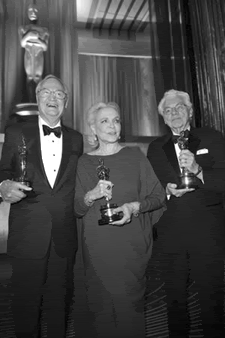
The reason the luvvy orations were given so much airtime stems from a number of honorary awards being handed out months earlier. In past years, some winners were presented with their (often belated) Oscars, but this year the lot were blown off via a montage.

What that alone signalled is that film history and the members who furthered the art of filmmaking is only of note if it's recent, tied to enough living colleagues, or their significance can be explained in a few easy sound-bites.


Roger Who? Lauren Who? Gordon Who?


Those blown through in the who-were-these-people-again montage included producer/director and indie icon Roger Corman (The Intruder), cinematographer Gordon Willis (The Godfather trilogy), producer (Angels and Demons) and former seventies Warner Bros. executive John Calley, and actress Lauren Bacall (Key Largo), who was at least singled out by Queen Latifah for the audience's benefit.

The dead celebrity montage (“In Memorium”) was underscored by a solo rendition of The Beatles' “In My Life” by James Taylor, and the list was much more compact than in prior years.

The only technical blunder was the decision to cut from the montage to a wide shot of the darkly lit stage, where one could glimpse an elder gentleman conducting an orchestra in the projected film footage. No captions appeared on the TV, so most probably didn't know the composer being slighted was Maurice Jarre (Lawrence of Arabia, Doctor Zhivago). A simply Google query also reveals a number of artists left off the roster, including Farrah Fawcett. (Anyone remember Sunburn? Or that famous poster?)

The sole dead notable given a space of stage time was writer/director/producer John Hughes, who died suddenly in 2009. The tribute began with Matthew Broderick (Ferris Bueller's Day Off) and Molly Ringwald (Sixteen Candles), and as expected, when the curtain rose, there were more members of the Brat Pack who paid their respects to the man who redefined (if not created) the teen film for all ages.

Hughes' family was seated in the front of the audience and observed the mix of verbal and montage material, but the handful of spoken words by the Brat Packers seemed trimmed for time. (Click HERE for a blog regarding supposed sudden interest in some of Hughes' unfilmed screenplays.)

Marc Shaiman's position as conductor ensured the music was energetic, and the seamless transitions between many themes throughout the telecast made longer awards segments less lumbering than they really were.

The night's oddest moments: George Clooney looking strangely glum in several creepy close-ups, and Quentin Tarantino looking ashen after Bigelow was anointed Best Director. Was QT deep in thought, or was some of his ego voiding into the seat cushion?

Awards shows are a thing that can't really be improved because the basic formula is people talking, clapping, walking to accept awards, and ad breaks. The interpretive dance vignettes for Best Score are always ridiculous, the Best Song medley are often patently awful, and someone important often gets ignored in the ceremonies because it's the stars that are the main attraction.

Last night's luvvy orations could be seen as offshoots of reality TV: the stars are There. It's their friends 'unexpectedly' telling the world why Gene Bibbleford is a humanitarian, and Sally Hoofengrubber-Shutzmiller has inspired millions of actresses to believe in Art, love short brown people, and fight for the rights of thumbless ex-hookers and the reunification of lost pet rocks in the province of Pinikindu.

The idea reads noble on paper, but it's dull in real-time TV, and it robbed the aforementioned Honorary Oscar winners of their limelight in front of millions. Besides, from the extracts of that ceremony and dinner, everyone seemed to be having WAY more fun, telling wild tales of working with Roger Corman, his legendary cheapness, the mass of young filmmakers he inspired, Calley's creatively rewarding tenure at Warner's, and Bacall's dry persona at the podium. People were laughing and drinking that night, which looked far more amusing than the luvvy sessions last night, and one wishes the Honorary Awards Dinner was telecast instead.

The only real surprise: Sandra Bullock winning Best Actress for The Blind Side, which I understand is a populist feel good film that engages broad audiences from right, left, and centrist politics (but probably nauseates cynical writers, or those feeling the movie was Oscar bait that hit paydirt. No doubt it'll rent very well on DVD).

The expansion of Best Picture nominees from 5 to 10 isn't some 'restoration' of a great tradition scrapped by the mess of WWII in 1944. '43 was the last year they had 10 nominees because the Oscar body likely felt it was too many damn movies, and made the awards festivities longer than necessary. Some probably felt a few in the tally weren't deserving of being called 'the best that Hollywood had to offer' and knocking it down to a top 5 was an improvement, which is why it endured for over sixty years.

During that slab of time, winners were announced to the general public by radio, newsreels in theatres, and after the invention of TV, Oscar telecasts, satellite TV feeds, and online streaming.

The 'Top 10' syndrome was a dumb marketing ploy that allowed more producers/studios to slap pictures of the bald statue in poster and DVD art, let ABC promote the night not as a celebration of artistry but a smack-down between 10 titans, and give the impression the night was more embracing of commercial successes rather than critical darlings.

The Academy will probably try out the Top 10 for another year, and if it proves to be too unwieldy, it'll get scrapped due to a re-imagining and rebooting of the awards formula (which would be code for AMPAS members unwilling to sit though ten nominated movies, some of which run close to three bloody hours. Just wait – they'll be whining cum the fall of 2010).

Bullock winning a bald statue probably makes her the only actress to win both an Oscar and a Golden Razzie Award in the same year. So, to end off this editorial blathering, those wanting to check out Oscar winners and see some video clips of the speeches et al, there's the official site. Those wanting to see nominees and winners of rotten filmmaking, as well as Bullock's other acceptance speech for All About Steve can find further details at the official Razzie site.

Those expecting comments on Barbara Wawa's final Oscar Special will find none from me because half of Walters' hour-long show consisted of clips from prior interviews that were interminably boring, but at least they were less grating than the Red Carpet feeds run by various affiliated and starstruck networks and cable stations, like Canada's CTV, who pushed their team of plastic eTalk dollies onto the carpet to extract useless verbal chatter from stars.

TCM's own programming featured Oscar winning films in February and early March, culminating in one of the most infamous stinking turds ever made, 1966's The Oscar, which aired Sunday at 8pm. I'll have a review of this brilliantly awful lump of coal shortly, as well as several soundtrack reviews.


- MRH

0

2010 Genie Award Nominees

Announced Monday March 1st are the nominees for the 28th Annual Genie Awards. For those a tad confused about the Genie's identity, here's a simple breakdown:

Oscar = American
BAFTA = British
Genie = Canadian, like Oscar and BAFTA, but not
Juno = Canadian MUSIC, not film
Gemini = Canadian TV, not film
Genie = CANADIAN FILM, not like Oscar / American film / bald statue / heavy paperweight

All clear?

Excellent.

The awards will be handed out in Toronto, April 12th, with Gordon Pinsent hosting the televised ceremonies, although what network and time isn't clear at the Genie's official website, since the stated airdate (and previous year's winners) is frozen for the year 2008.

Ahem.

A pleasant surprise is how many of the films, both in English and French, are available on DVD and Blu-ray, which has to be a positive signal that, while Canadian films still have to fight for theatrical screen time, there are more options out there for home video (or everyone just smartly planned ahead in their marketing strategies). All of the films are out, and several were released prior to March 1st, which makes it easy for anyone to sample some of the best in Canadian film before the awards ceremonies in April.

So - Here are the nominees in each category, with titles currently on video hyperlinked to related reviews / Amazon.ca links:

.
BEST MOTION PICTURE / MEILLEUR FILM

3 SAISONS – Maude Bouchard, Jim Donovan, Sandy Martinez, Bruno Rosato
BEFORE TOMORROW – Stéphane Rituit
FIFTY DEAD MEN WALKING – Shawn Williamson, Stephen Hegyes, Peter La Terriere, Kari Skogland
NURSE.FIGHTER.BOY – Ingrid Veninger
POLYTECHNIQUE – Maxime Rémillard, Don Carmody

.

.
ACHIEVEMENT IN DIRECTION / MEILLEURE RÉALISATION

MARIE-HÉLÈNE COUSINEAU, MADELINE PIUJUQ IVALU – Before Tomorrow
KARI SKOGLAND – Fifty Dead Men Walking
CHARLES OFFICER – NURSE.FIGHTER.BOY
DENIS VILLENEUVE – Polytechnique
BRUCE MCDONALD – Pontypool

.

.
ORIGINAL SCREENPLAY / MEILLEUR SCÉNARIO

ATOM EGOYAN – Adoration
ÉMILE GAUDREAULT, IAN LAUZON – De père en flic / Father and Guns
CHARLES OFFICER, INGRID VENINGER – NURSE.FIGHTER.BOY
JACQUES DAVIDTS – Polytechnique
DAVID BEZMOZGIS – Victoria Day

.

.
ADAPTED SCREENPLAY / MEILLEURE ADAPTATION

MARIE-HÉLÈNE COUSINEAU, SUSAN AVINGAQ, MADELINE PIUJUQ IVALU – Before Tomorrow
KARI SKOGLAND – Fifty Dead Men Walking
TONY BURGESS – Pontypool

.

.
PERFORMANCE BY AN ACTOR IN A LEADING ROLE / INTERPRÉTATION MASCULINE DANS UN PREMIER RÔLE

JEAN-CARL BOUCHER – 1981
PAUL DYLAN IVALU – Before Tomorrow
JOSHUA JACKSON – One Week
CLARK JOHNSON – NURSE.FIGHTER.BOY
STEPHEN MCHATTIE – Pontypool

.

.
PERFORMANCE BY AN ACTRESS IN A LEADING ROLE / INTERPRÉTATION FÉMININE DANS UN PREMIER RÔLE

MADELINE PIUJUQ IVALU – Before Tomorrow
KAREN LEBLANC – NURSE.FIGHTER.BOY
CARINNE LEDUC – 3 Saisons
GABRIELLE ROSE – Mothers&Daughters
KARINE VANASSE – Polytechnique

.

.
PERFORMANCE BY AN ACTOR IN A SUPPORTING ROLE / INTERPRÉTATION MASCULINE DANS UN RÔLE DE SOUTIEN

PATRICK DROLET – De père en flic / Father and Guns
JOHN DUNSWORTH – Trailer Park Boys: Countdown to Liquor Day
MAXIM GAUDETTE – Polytechnique
RÉMY GIRARD – De père en flic / Father and Guns
SCOTT SPEEDMAN – Adoration

.

.
PERFORMANCE BY AN ACTRESS IN A SUPPORTING ROLE / INTERPRÉTATION FÉMININE DANS UN RÔLE DE SOUTIEN

LIANE BALABAN – One Week
MARIE BRASSARD – Les grandes chaleurs / Heat Wave
MARTHA BURNS – Love & Savagery
ISABEL RICHER – Babine
SONIA VACHON – 5150, rue des Ormes / 5150 Elm’s Way

.

.
ACHIEVEMENT IN ART DIRECTION, PRODUCTION DESIGN / MEILLEURE DIRECTION ARTISTIQUE

DIANA ABBATANGELO – NURSE.FIGHTER.BOY
SUSAN AVINGAQ – Before Tomorrow
JEAN BABIN – Grande ourse: La clé des possibles / The Master Key
EVE STEWART – Fifty Dead Men Walking
PATRICE VERMETTE – 1981

.

.
ACHIEVEMENT IN CINEMATOGRAPHY / MEILLEURES IMAGES

STEVE COSENS – NURSE.FIGHTER.BOY
JONATHAN FREEMAN – Fifty Dead Men Walking
PIERRE GILL – Polytechnique
RONALD PLANTE – Grande ourse: La clé des possibles / The Master Key
ALLEN SMITH – Les doigts croches / Sticky Fingers

.

.
ACHIEVEMENT IN COSTUME DESIGN / MEILLEURS COSTUMES

ATUAT AKITTIRQ – Before Tomorrow
CARMEN ALIE – Grande ourse: La clé des
possibles / The Master Key
SARAH ARMSTRONG – NURSE.FIGHTER.BOY
BRENDA BROER – Cairo Time
ANNE-KARINE GAUTHIER – 1981

.

.
ACHIEVEMENT IN EDITING / MEILLEUR MONTAGE

ALAIN BARIL – 5150, rue des Ormes / 5150 Elm’s Way
RICHARD COMEAU – Polytechnique
FRANÇOIS NORMANDIN, JIM DONOVAN – 3 Saisons
MICHEL GROU – Grande ourse: La clé des possibles / The Master Key
JIM MUNRO – Fifty Dead Men Walking

.

.
ACHIEVEMENT IN MAKE-UP / MEILLEURS MAQUILLAGES

DJINA CARON, MARTIN RIVEST – Polytechnique
DJINA CARON – Grande ourse: La clé des possibles / The Master Key
DIANE SIMARD, RÉJEAN GODERRE – Love & Savagery
MICHELINE TRÉPANIER, LINDA GORDON – 1981
ROBBI O’QUINN, LEANNE MORRISON-FREED – You Might As Well Live

.

.
ACHIEVEMENT IN MUSIC – ORIGINAL SCORE / MEILLEURE MUSIQUE ORIGINALE

BENOÎT CHAREST – Polytechnique
BERTRAND CHÉNIER – Love & Savagery
CHRISTIAN CLERMONT – 5150, rue des Ormes / 5150 Elm’s Way
NORMAND CORBEIL – Grande ourse: La clé des possibles / The Master Key
BEN MINK – Fifty Dead Men Walking

.

.
ACHIEVEMENT IN MUSIC – ORIGINAL SONG / MEILLEURE CHANSON ORIGINALE

SUSAN AVINGAQ – Before Tomorrow – "Pamani"
JOHN WELSMAN, CHERIE CAMP – NURSE.FIGHTER.BOY – "Oh Love"
SARI DAJANI, IOHANN MARTIN, RUDY TOUSSAINT, JOHN VON AICHLINGER – Les grandes chaleurs / Heat Wave – "Bon Swa"

.

.
ACHIEVEMENT IN OVERALL SOUND / MEILLEUR SON D’ENSEMBLE

MARIO AUCLAIR, DANIEL BISSON, LUC BOUDRIAS, JEAN-CHARLES DESJARDINS – Grande ourse: La clé des possibles / The Master Key
STÉPHANE BERGERON, PIERRE BLAIN, JO CARON, BENOÎT LEDUC – Polytechnique
CLAUDE HAZANAVICIUS, DANIEL BISSON, JEAN-CHARLES DESJARDINS, BERNARD GARIÉPY STROBL – Love & Savagery
RICHARD LAVOIE, ARNAUD DERIMAY, JEAN-CHARLES DESJARDINS, BERNARD GARIÉPY STROBL – Before Tomorrow
SIMON GOULET, BERNARD GARIÉPY STROBL – 5150, rue des Ormes / 5150 Elm’s Way

.

.
ACHIEVEMENT IN SOUND EDITING / MEILLEUR MONTAGE SONORE

PIERRE-JULES AUDET, MICHELLE CLOUTIER, JACQUES PLANTE, JEAN-FRANÇOIS SAUVÉ – Grandeourse: La clé des possibles / The Master Key
MATHIEU BEAUDIN, JACQUES PLANTE – 5150, rue des Ormes / 5150 Elm’s Way
CLAUDE BEAUGRAND, GUY FRANCOEUR, CAROLE GAGNON, CHRISTIAN RIVEST – Polytechnique
GARRETT KERR, FRED BRENNAN, PAUL GERMANN, STEVE HAMMOND, MISHANN LAU – NURSE.FIGHTER.BOY
OLIVIER CALVERT, NATALIE FLEURANT, FRANCINE POIRIER, LISE WEDLOCK – Babine

.

.
BEST FEATURE LENGTH DOCUMENTARY / MEILLEUR LONG MÉTRAGE DOCUMENTAIRE

A HARD NAME – Kristina McLaughlin, Michael McMahon, Alan Zweig
LES DAMES EN BLEU / LADIES IN BLUE – Claude Demers
INSIDE HANA’S SUITCASE – Larry Weinstein, Rudolf Biermann, Jessica Daniel
PROM NIGHT IN MISSISSIPPI – Patricia Aquino, Paul Saltzman
RIP: A REMIX MANIFESTO – Mila Aung-Thwin, Kat Baulu, Brett Gaylor, Germaine Ying-Gee Wong

.

.
BEST SHORT DOCUMENTARY / MEILLEUR COURT MÉTRAGE DOCUMENTAIRE

THE DELIAN MODE – Kara Blake, Marie-Josée Saint-Pierre
PASSAGES – Marie-Josée Saint-Pierre
PETROPOLIS: AERIAL PERSPECTIVES ON THE ALBERTA TAR SANDS – Peter Mettler, Sandy Hunter, Laura Severinac --- DVD available March 30

.

.
BEST LIVE ACTION SHORT DRAMA / MEILLEUR COURT MÉTRAGE DRAMATIQUE

DANSE MACABRE – Pedro Pires, Catherine Chagnon
GILLES – Constant Mentzas
PRINCESS MARGARET BLVD. – Dan Montgomery, Kazik Radwanski
TERRE DES HOMMES / LAND OF MEN – Ky Nam Le Duc
LA VIE COMMENCE / LIFE BEGINS – Élaine Hébert, Émile Proulx-Cloutier

.

.
BEST ANIMATED SHORT / MEILLEUR COURT MÉTRAGE D’ANIMATION

RUNAWAY / TRAIN EN FOLIE – Derek Mazur, Cordell Barker, Michael Scott
THE SPINE / L’ÉCHINE – Steven Hoban, Chris Landreth, Marcy Page
VIVE LA ROSE – Michael Fukushima, Bruce Alcock, Annette Clarke, Tina Ouellette

.

.
GOLDEN REEL AWARD

De père en flic / Father and Guns - Denise Robert, Daniel Louis

.

.
CLAUDE JUTRA AWARD

J'ai tué ma mère / I Killed My Mother - Xavier Dolan

.

.
ACADEMY ACHIEVEMENT AWARD

Mel Hoppenheim

.

.

.
--30--
0

Bug-Eyed Nostalgia

Anchor Bay Canada’s recent release of R.W. Goodwin’s Alien Trespass (2009) had me recalling a pair of similar efforts that capture the essence of monster B-movies, and celebrate somewhat differing genre elements.

This isn’t to negate the impact and continuing attraction of the classic Universal monsters triumvirate – the Wolf Man, Dracula, the Mummy - that debuted in the thirties, and were beaten to death in several sequels and crossover films over the next ten or so years, but there are several reasons why fifties and sixties monster and alien films are still cherished by ongoing generations.

From a technological angle, the fifties were partly about new toys that changed the lifestyles of ordinary families, and that sense of society being improved through science is something we still share, as are new forms of communications and entertainment. Even the portability of entertainment – portable radios and TVs, 16mm film projectors – could be regarded as antecedents of MP3 players, iPhones and other portable digital media players.

But more than in later decades, the new suburban lifestyle was repeatedly portrayed as the ideal. For storytellers, that strange perfection seemed to mandate some kind of threat, and it was natural that nuclear mutants and alien invaders became the key antagonists and threats to suburban society. These threats offered no benefits; it was total destruction and annihilation of the human species, as well as all the religious and cultural goodies that were tied to the Perfect Life.

Bugs eat people. Aliens kill people and destroy entire civilizations. Nuclear bombs create monsters from ordinary backyard bugs, slugs, and rodents. Unlucky humans exposed to radiation would glow in the dark, went mad, and created explosions that damaged or destroyed our beloved technological infrastructure.

The forties still had a kind of rural feel, but the surburbanized fifties and their nuclear family units were modern.

Kids were growing up in a schizophrenic world where life was supposed to be good, but monsters were everywhere. If you lived in a remote desert town, you were far more likely to be killed by an alien craft or giant slabs of monolithic crystals. Or mole creatures would burrow up from the depths. Maybe your cousin would start acting funny when a full moon was out, or perhaps a doctor, once a trusted member of society and guarantor of your passport – abducted youths and turned them into monsters through weird transplants.

The world was supposed to be better after WWII, but the Soviets were threatening the free world and competing with America’s own military goodies. With space penetrated by the Reds and Sputnik, the planet was doomed unless something could be done.

Were the monsters exciting distractions for kids wanting to escape dour news reports of spies and un-American behaviour?

If the nuclear family was the ideal, why were so many creatures trying to kill it?

If science could cure age-old plagues, why was a man condemned to shrink until he became one with the atom, and then disappear into oblivion?

The three films I chose to showcase present very different nostalgic views of monster films and their inhuman threats.

Alien Trespass (2009) is a tongue-in-cheek homage to the clichés and silly cinematic behaviour of humans when an alien ship crashes in the desert. Borrowing from several classic sci-fi films, the plot celebrates the style, flaming Technicolor brilliance, and character clichés of the fifties (including nerdy, egghead scientists), but with a tangible affection for them all. More interesting is the filmmakers’ decision to publicize Alien Trespass not as an homage, but as a lost artifact from 1957.

Joe Dante’s Matinee (1993) is set in 1962, but it’s told from the angle of teens already familiar with monster movies from their childhood during the late fifties, and their gradual sway towards darker material, like thrillers made by an auteur named Lawrence Woolsey.

Patterned after William Castle, the film’s writers made their fictional ‘Master of Suspense’ a brand name, much in the way Alfred Hitchcock sold his film and TV productions through voice, caricatures, and signature music, but Woolsey is quite different from Castle in one major way: he has yet to be influenced by Hitchcock and make the kind of mystery thrillers Castle derived during the early sixties - Castle’s cinematic heyday.

And yet the posters in the theatre where Woolsey’s latest film, “Mant,” is set for a sneak preview, are of more mature thrillers, like Panic in Year Zero (released in 1962), so there are a number of things converging in Dante’s film: there’s the tribute to fifties monster movies and classic carny showmanship, and a subtle lament as older teens catch the films more for laughs than thrills because the monsters feel dated, and aren’t as scary as the real effects of nuclear war being dramatized in dour films like Panic in Year Zero.

Monster movies were being superseded by tales tied to more newsworthy dangers, and the idyllic nuclear family was showing cracks from contemporary social ills – single parent families, alcoholism, spousal abuse, child abuse, and less trust for the neighbours who used to be regarded as extensions of an urbanized, street-long family. The fear wasn’t that the mom of your next-door friend may have married a Commie, and was now mutating into an alligator, but of a spy selling secrets to an evil empire set on burying your city with a grand nuclear salvo.

How could a giant bug or monkey compete with that?

It couldn’t, and as thrillers about homicidal ax-wielding mothers (Castle’s 1961 shocker Homicidal) and cross-dressing serial killers overtook monsters (Hitchcock’s Psycho), the only place aliens and big bugs could survive was the realm of Z-grade schlock, often made by hacks who possessed rudimentary filmmaking skills. The product was aimed solely at the drive-in, it was a bit riskier with sex and violence, or was made so cheap to ensure the most money possible was earned up front before fast word-of-mouth told other potential moviegoers the film stunk like rotting potatoes.

Larry Blamire’s Lost Skeleton of Cadavra (2001) celebrates cinematic ineptitude, incoherent plotting, bizarre characters, and el cheapo production values to such perfection that is can’t transcend the nature of schlock into something less awful. It’s a niche film for fans of vintage abysmal filmmaking. Like Alien Trespass, there are aliens and a mutant on the loose, but by adopting the same primitive style and technical sophistication of an Ed Wood, Jr., it tends to grate much like the interminable The Astounding She-Monster (1957).

Alien Trespass celebrates the genre’s highpoint, Matinee its gradual demise, and Cadavra satirizes the low points as the remaining practitioners were not film school newbies, but rejects who knew how to turn on the camera, but often forgot to load the film magazine.

The directors and writers of these nostalgia trips grew up on the original monster films during their runs in theatres and TV airings, whereas the sensibilities from younger filmmakers are noticeably different.

The 2001 remake of Earth vs. the Spider combined visual elements from several decades to upgrade the B-movie plot and character archetypes, whereas Eight Legged Freaks (2002) took the concept of a mutant bug infestation threatening mankind and transposed it to a modern (albeit desert) locale where the onslaught of spiders and humanity’s last stand was goofy – something completely absent in classic bug fodder like Them! (1954).

And then there’s Ron Underwood’s Tremors (1990), which felt like a vintage monster film, but was populated by a crop of oddball townspeople reminiscent of small-town TV sitcoms.

It’s also worth pondering how Matinee would’ve been different had Dante’s contemporary, Steven Spielberg, taken a poke at the story, but then one only need examine Twilight Zone: The Movie (1983), which Spielberg supervised as a vehicle for a quartet of filmmakers with differing styles making their own nostalgic tribute to an early sixties TV series rooted in seen and unseen monsters.

Dante went for eerie chaos, dark and surreal characters, and a cartoon finale that wasn’t really resolved, whereas Spielberg’s tale dealt with a group of seniors’ seething desire to regress as children, and run wild and free in a preposterous fantasyland where a kid could play forever, and never worry about disintegrating dirty clothes, stealing food, or getting tetanus from rusty fences.

Nostalgia’s a tricky thing to pull off…


- MRH

0

Some Funkafied Leverage

Con movies are already tough to pull off. You have to have characters that aren’t mere reworkings of existing clichés, and plot twists that aren’t blatantly derivative and leave you insulted.

Compare The Score (2001) with Inside Man (2006). The former has major actors (Brando-DeNiro-Norton) stuck in a banal story that meanders and lumbers along, whereas the latter is a beautifully structured con with a solid reveal that has you respecting the characters for their ingenuity, and leaving the theatre with a smile for being taken for a fun ride.

Repeating a successful formula on a weekly basis is an even bigger challenge when the budget is smaller, and the time allotted to prepping, enacting, and wrapping up a con is restricted to 40 minutes.

Moreover, there’s the challenge of creating thieves you like rather than thieves who deserve to be beaten up with a lead pipe.

(Actually I’m wrong there. Thieves invigorated by the con and a sense of Robin Hood sense of do-goodery creates contrasts so our loathing is redirected towards bigger, colder, greedier thieves. That, plus genial thieves conning evil thieves who kill innocent people works, too, as with The Italian Job.)

TNT’s Leverage debuted in 2008, and the DVD came out a year later. The gradual buzz has turned the show into a hit, and with Season 2 wrapping up just last week, the DVD will be released May 25, and production on Season 3 has already begun.

The advantage of the tight broadcast and DVD release dates is that viewers hooked on the show won’t have to wait long to revisit the show on home video, and newbies wanting to catch up with prior seasons before the new one airs can do so with some pretty loaded DVD sets.

Those wanting more Leverage can also revisit the series via La-La Land’s CD, which features all of Joseph LoDuca’s funky signature themes and some dramatic and source cuts.

LoDuca has written a lot of music since his 1981 debut with Sam Raimi’s Evil Dead, and while his name will always be tied to Raimi’s bloody exploits of a schmo named Ash trying to fend off pure evil, the composer’s been writing music for many other genres in TV and film, but Leverage is definitely one of his best works to date.

Con films need electric, witty music, and LoDuca’s series theme encapsulates what it’s like to be in on a con, and be a part of the team. The undulating bass line just keeps pulling us into each drama and, as I discovered, if one watches the series in clumps of 2-3 episodes, the theme also worms its way into the brain, playing in the background during a walk down the street, sitting quietly in the living room, or chopping garlic and adding it to simmering onions before they start to brown. (It’s about frantic movement, see?)

So in addition to a review of the soundtrack CD which assembles material from the show’s first two seasons, I’ve also uploaded an interview with LoDuca, where he talks about the show’s distinct sound, as well as some quick comments on a personal LoDuca favourite of mine, the cult series American Gothic (1995-1996), which (in my eyes) CBS killed with malice. (The DVD set from Universal is still in print, and is worth hunting down.)

There’s also a lengthy review of Leverage, Season 1 (Paramount), and unlike the Doc Martin series reviews, it’s spoiler-free!


- MRH

 
Copyright © mondomark