Showing posts with label Cold War. Show all posts
0

John Huston’s Cold War Thrillers

Not your conventional old stogie.

Just uploaded are a pair of very good – no, I’d say excellent – Cold War espionage films directed by John Huston. Known for his affinity for losers and crazy dreamers who never manage to reach their ultimate goals (or at least must severely lose a pound of flesh to get past the first border crossing), Huston’s later films weren’t always box office blockbusters, but for the most part they were interesting artistic ventures made by a big, wiry man with a grand persona.

If you’ve seen Clint Eastwood’s White Hunter, Black Heart (1990) – and you really should if you haven’t – it sort of encapsulates the director’s odd blend of filmmaking and adventurism. Huston went to Africa to make movies and shoot big game. In White Hunter, he wanted an African elephant; and in Nevada for The Misfits (1961), there was the gambling, and commandeering an over-budget production with three of Hollywood’s biggest and most expensive stars.

Filmmaking for Huston always seemed to be about the challenge, and having fun with a good cigar stuck between his grandiose, mischievous smile, or having an awesome drinking buddy like Humphrey Bogart (The African Queen) or Errol Flynn (The Roots of Heaven). One reason Huston didn’t get sick during filming in exotic locales is the booze: if you increase the alcohol percentage to borderline toxic, you make it impossible for bugs to survive long enough to infect you. (At least that’s the theory which worked with Flynn during the shooting of Roots.)


From Twilight Time comes The Kremlin Letter [M] (1970), a forgotten but really well-aged espionage thriller whose tone and meanness I swear were borrowed by John Frankenheimer and David Mamet for Ronin (1999). There’s some striking tonal similarities, but Kremlin is a much meaner film about desperate characters sharing pretty dismal futures – hardly elements that would’ve made the kind of box office hit Huston was hoping for.

The film’s been announced for a Region 2 DVD July 25 via Eureka Entertainment, but TT’s Region 1 disc (limited to 3000 copies) includes an isolated music track of Robert Drasnin’s bleak little score, and is available exclusively from Screen Archives Entertainment.

Those curious about TT’s upcoming Blu-ray and DVD editions of The Egyptian (1954) can read a detailed interview with Nick Redman at Blu-ray.com. Apparently the company’s licensed 100 films from Fox, and I’m keeping my fingers crossed some of those anamorphic CinemaScope productions out in Spain will finally get their due in North America. There’s no reason why The Roots of Heaven (1958) or Inferno (1953) can’t be released here. None.


Also reviewed is Huston’s second seventies espionage thriller, The MacKintosh Man [M] (1976), starring Paul Newman in a perfectly tailored role of a no-nonsense thief / spy. It as easy for the studio to package a trailer with plenty of money shots and quick quips, but selling the film was clearly tough for Warner Bros., because it moves from one genre to another within its first hour. It’s also a gem that deserves a peek, and Warner Home Video released it a few years ago as a standalone edition and in a Paul Newman-themed boxed set.

While we’re on the subject of Huston, I should also point out the late August screenings of The Misfits at the TIFF Bell Lightbox. Montgomery Clift, Clark Gable, Marilyn Monroe, Eli Wallach, Kevin McCarthy, Thelma Ritter, Arthur Miller, and Alex North. Not a happy film, considering three of the leads were dead within a few years after the film’s release, but it’s a striking production that’ll look & sound great on the big screen.

Also announced in the TBL’s programme book is an upcoming salute to Grace Kelly, featuring Rear Window (1954), To Catch a Thief (1955), and Dial M for Murder (1954). I’m so there, but it would be amazing if the TBL could get their hands on a restored 3D print of Dial M. I’ve seen a worn print at the old Festival Cinemas’ summer 3D series, and even in WobblyVision & browning film stock, it still looked good.

Coming shortly: the saga of Coffin Joe.


Mark R. Hasan, Editor
KQEK.com
0

Berlin's Cold War Heat

Back in September, I posted reviews of Robert Siodmak’s Escape from East Berlin (1962) and the documentary/travel video Mauerflug (‘flight over the Berlin Wall’) as the first in a series tied to the giant reverse-chastity belt that was designed to prevent East Germans from penetrating the west.

Here in Part Two, I’ve uploaded a pair of reviews dealing with Berlin before the Cold War, and the city smack in the middle of it. Both productions are biased towards British POVs of the city, and don’t really present the drama from the average person’s stance.

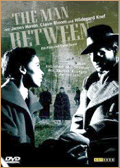
The Man Between (1953), for example, has a snotty and ignorant waif visiting her brother in the British Sector, after which she ends up in the East and has to flee with the gangster she’s fallen for during her exotically dangerous sojourn. The film – still unavailable in Region 1 land – could be regarded as director Carol Reed’s second poke at postwar thrills-among-the-ruins, after The Third Man (1949), although nowhere as clever nor intriguing.

James Mason pulls off a decent East German (even his pronunciation of German is serviceable), and Claire Bloom looks beautiful in spite of playing an idiot. The location footage and recreation of ruined quarters is stellar, however, as is John Addison’s thematic material.

Reed’s film takes place pre-Wall; the GDR regime was starting to tighten its grip on citizens and crack down on flights to West Berlin, and barbed wire and military checkpoints were more severe, but one could still find venues to exit the Eastern Sector.

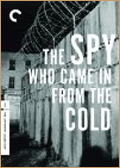
The Spy Who Came In from the Cold (1965) was a superb realist drama – WASP-style – taken from John le Carré’s best-selling espionage thriller about a British spy who feigns revulsion towards the British government/western politics and heads over to East Germany with his suitcase of secrets.

Spy is the antithesis of sixties spy films because it’s about characters, spy psychologies, and outright misery. Richard Burton is beautifully subdued under Martin Ritt’s direction, Oskar Werner steals the film at every angle, and Claire Bloom plays a far less naïve woman, although she’s essentially the perfunctory love interest.

Only the last scene takes place in East Berlin (er, a custom set built in Ireland), and the obligatory flight to the west is shorter, less elaborate, but far more tense than what Reed prolonged in his flat film.

The reason Ritt’s finale works in its compact dramatic state is purely because of the characters we want to see happy after been abused by governments and ideological monsters. They deserve a chance at peace, and the tension one sees as Burton tries to keep his performance style under several notches actually makes his scenes more compelling, because one senses his character is struggling with emotions kept locked up due to his risky profession.

There are no explosions, tricked-out Aston Martins, or bald men trying to destroy planet Earth with a lethal gas, but it’s a rewarding drama, as well as another fine example of British Bleakism. Spy isn’t precisely about Berlin – it’s the kludge centre where everything happens once the various levels of badness comingle – but it’s symbolic of the city being mucked up because the postwar winners are playing an elaborate game of chess.

Author le Carré points out in an interview on the Criterion DVD that while one man is sacrificed in the film’s pivotal courtroom sequence, many more of his colleagues and underlings will probably lose there jobs, their dignity, and some their lives due to automatic guilt-by-association.

Paramount released their own bare bones edition of Spy on DVD, but Criterion’s special edition from 2008 is worth every penny for the super transfer (Sol Kaplan’s grim little score is in true stereo!), plus some excellent extras.


- MRH

 
Copyright © mondomark