Showing posts with label Tinto Brass. Show all posts
0

Eros IV: Tinto Brass in HD


Although released last year on DVD, Monamour [M] (2006) makes its Blu-ray debut, joined by Kick the Cock (2009), the short film directed by Brass, starring (and written by) model Angelita Franco.

Brass’ work in the short film format goes back to his first film, the rarely-seen Spatiodynamisme (1958), made for the Cinematheque Francaise, with Henri Langlois credited as producer, and one could technically include his segments in the anthology My Wife / La mia signora (1964), and I Miss Sonia Henie (1971), but Kick the Cock is probably the first time he’s returned to the genre, albeit in a blatantly softcore genre with simulated ‘relief’ moments performed by none other than himself and a robust phallus with plenty of spouting ‘canon fodder.’
0

Eros I: Bum-bums, & alternative cultural titillations

Please note: hyperlinked film titles are for reviews on the Main site; a hyperlinked "(M)" denotes review at KQEK.com Mobile


"Eros" is the buzz-word, or the veiled nomenclature, for things smutty-but-artistic, and it was likely conceived so adults could discuss dirty things without actually feeling guilty.

For example, a conversation could take place on a bus, and if one maintained an ongoing use of 'veiling' terminology, one could discuss the dirtiest act imaginable, and only those-in-the-know would know what you knew, while everyone else was safely potected by an invisible sheet of textual pureness (Catholic guilt?), knowing nothing.

During the seventies, the puritanical streak in American films more or less meant erotica appeared as an ingredient in exploitation films, softcore, and hardcore.

In Canada, Quebec more or less represented the country's risque output which fizzled out by the mid- seventies, although one could include France-Canada co-productions, and maybe the odd tax shelter film. Note: Circle of Two does not count.

In Italy, erotica appeared in a fairly broad range of soft, hard, sexploitation, eurosleaze, and comedic films, but in Japan, the restriction against showing pickles, beavers, and any activity between the lower naughty bits would've yielded films whose core eroticism was neutered, so the alternative was to riff European sub-genre streams like naughty teachers, naughty students, naughty prostitutes, and a few storylines and perspectives that weren't exactly politically correct.

Impulse Pictures have been releasing rare erotic films for the past few years - the wacky German Schoolgirl Report series, Swedish meatball classics like Anita (1973)  - and their latest cultural foray is the Roman Porn series, begun by Japanese studio Nikkatsu to get adult posteriors back into theater seats.


Kick-starting the DVD wave is The Nikkatsu Roman Porn Trailer Collection (M), featuring 38 trailers of naughtiness, plus a bonus feature. (The first titles in Impulse's new wave of feature-length classics will be Female Teacher: Dirty Afternoon, and Debauchery.)

Leaping back to Italy, the sex comedies of the seventies live on via the (geuinely) inimitable persona of Tinto Brass, and wonders behold, Tinto has gone digital!

His first HD film (via Cult Epics) is Monamour (M), made in 2005, and looking far more filmic than the indie horror shocker The Rig (M), made in 2010, and reviewed this past weekend.


How is it that Brass, the king of the posterior, emperor of the round rumpty-dumpty, spiritual leader of unfettered nethers, and iconoclast of the bountiful bum-bum can make an inventive movie experience that betters the efforts of younger, hungrier emerging filmmakers schooled in the latest gear?

Because he's a filmmaker [who succumbed to the erotic bug during London's Swinging Sixties], a veteran of Italy's New Wave [who went rogue], and a striking editor whose concept of montage is rooted in the rule-breaking techniques of Godard, if not the abstract and impressionistic brilliance of editor Franco Arcalli (with whom he worked on Deadly Sweet).

Eros is fun, silly, provocative, and really, really educational. The reviews support these facts with irrefutable evidence, and as we've learned today, Eros has artistry.

Ahem.


Mark R. Hasan, Editor
KQEK.com
0

Arrabal, Jodorowsky, Makavejev... and Brass?

Ooo... Barracuda...


Before his decadent switch to sexploitation and erotica, Tinto Brass made a pair of films wherein he experimented with sophisticated editing concepts (visually and aurally) to create narratives from loosely drawn concepts, as well as inject some commentary on the political and social turmoil of the times.


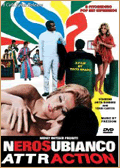
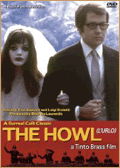
Both Attraction / Nerosubianco (1969) and The Howl / L’hurlo (1970) are more accessible than expected – each has a premise that pushes unexpected couples on wayward journeys – but they’re part of a wave of provocative films from European filmmakers designed to shock, upset, and titillate audiences.

The overall impetus was to show people moral and political issues using a subjective viewpoint (the filmmaker’s) and provoke some thought about what was going on, be it student protests against whatever war was being raged by a colonial power, sexual repression, or a communist regime shoving doctrine down the throats of its citizens in every manor and method possible.

Think a little for yourself, fight against a brutal regime, and enjoy the benefits of the human body – themes Brass weaves together in his raunchy political fable The Howl. Politics are less evident in Attraction (released in the U.S. by Radley Metzger’s Audubon Films under the cheat title The Artful Penetration of Barbara) because Brass was still having fun with the pop art of swing sixties London – a lingering interest from his prior film, the partial giallo Deadly Sweet (1967).

Whereas The Howl is a trippy little fable, Attraction unfurls like a contemporary music video, since the lead heroine’s adventures are comprised of musical vignettes where the score’s composers – members of the band Freedom – appear on camera and in scenes with other characters.

Cult Epics recently released the two films separately (and as part of a boxed set, alongside Deadly Sweet), and I’ve uploaded lengthy reviews for both.

Also added to the mix is a I Miss Sonia Henie, a rare short made for the 1971 Belgrade Film Festival wherein select directors - Karpo Acimovic-Godina, Tinto Brass, Mladomir 'Purisa' Djordjevic, Milos Forman, Buck Henry, Dusan Makavejev, Paul Morrissey, Frederick Wiseman - were challenged to shoot actors with a locked off camera and fixed lens, and figure out some way to work in the phrase “I miss Sonia Henie.”

The pieces were edited into a 14 min. film by Godina, and the results are expectedly uneven. Still unavailable on DVD, the short does pop up at rare screenings (MOMA included the film in a 2008 retrospective of Milos Forman), and segments are available at YouTube, with English subtitles.


So how does Tinto Brass fit in with cinema agitators Fernando Arrabal, Alejandro Jodorowsky, and Dusan Makavejev? The argument begins with The Howl


- MRH

0

Brass Candy

Boop-boop-a-doop!If one asked the average-average filmgoer (as opposed to the average, whose film diet probably omits most of Cuba Gooding Jr.’s spate of comedic dreck, which is a significant difference) questions about European cinema, there would probably be a blank stare, if not mere mentions of recent award-winning films or foreign films shared within the friend-family-marital realm. In other words: fairly bland, if not a safe taste for things uplifting, melodramatic, or pretty good – but not daring.

Now, daring doesn’t have to be naughty, but a bit of sixties/seventies political incorrectness never hurts, because sometimes within the confines of a once popular genre lie refreshing ideas that directors like Quentin Tarantino, Eli Roth, Edgar Wright and Martin Scorsese have been screaming about for years – more so with the younger batch of directors whose work embraces the often risqué technique as well as human behaviour from the (mostly) exploitation sub-genres.

Again, that doesn’t have to include naughtiness, but sometimes a bit of rudeness spices up the obligatory elements directors had to acknowledge to keep paying audiences ducky.

That’s why a giallo deals with murder/mystery/incoherent plotting, spaghetti westerns combine a style of music/cinematography/cruelty/morality/Mediterranean tanned cow punchers and healthy Italian/Brazilian/French/German/Spanish babes, and the sex comedy deals with sex/mistaken behaviour and an acknowledgement that (mostly male) audiences are supposed to be wearing big, dumb, placid grins when an Edwige Fenech (or the real Fenech) displays her extraordinary ubaldishness, and moves with cat-like ubaldinastity.

The aforementioned directors are also well aware, and have blabbed on in recent documentaries and featurettes, of the technical and stylistic elements that make European cinema so amazing. This isn’t a rejection of other countries and their cinema heritage, but there’s a sharing of genres, actors, and warping of conventions between American, British, Italian and occasionally German thrillers, as well as sex comedies.

Candy (1968) was sort of a blending of elements, except it fell flat on its ass because of excess (style and running time), a wonky structure, lack of coherence, a vapid leading heroine, and the sadness of seeing a few great actors doing truly embarrassing things.

It’s sad when an award-winning actor is doing dreck for money (Cuba Gooding voluntarily made Daddy Day Camp for his family, so he doesn’t count), but then there’s seeing Richard Burton, barely a few years after making Who’s Afraid of Virginia Woolf? (1966) and The Taming of the Shrew (1967), slurping up spilt alcohol from a glass-bottomed limo floor for what seems like an hour.

Is it funny? For a bit, and then it’s just painful.

Candy is not a good film and will never evolve into some underrated classic, but it has moments of arguable brilliance when the film camera, the actors, and editing capture the absurdity of Terry Southern’s outrageous writing style. He co-wrote with Stanley Kubrick Dr. Strangelove (1964), and wrote Barbarella (1967), and one gets traces of his insanity in Candy, as well as the best evocation of a Daffy Duck cartoon taken to its full narrative potential.

Anchor Bay released the DVD back in 2001, but it’s been out of print for a while now in Region 1 land, and the film needs a proper special edition. Historian commentary track, if not documentary, interviews, publicity archives, and a reassessment of what parts of Buck Henry’s film adaptation of Southern and Hoffenberg’s novel clicked.

The film was released by Cinerama Releasing Corporation, so perhaps like Bluebeard (1972), that dead company’s back catalogue is now handled by Lionsgate, a company known for good but perfunctory DVD releases of European classics, as well as superb special editions for recent American cult classics like Monster Squad (1987) and My Bloody Valentine (the original, not the poo-poo undie remake).

Someone should get cracking, seeing how Candy is now 40 years old.

Besides the overall train wreck appeal, part of that film’s notoriety is the casting of relative newcomer Ewa Aulin, a Swedish pastry who evolved from teen model to leading lady within a short period before leaving acting in 1973.

Aulin isn’t good in Candy, but then it’s hard to imagine anyone being able to bring depth to what’s basically Betty Boop as a blonde. Aulin as a mistress (Death Laid an Egg) or heroine work fine, and that’s where’ Deadly Sweet / Col cuore in gola (1967) comes in.

It’s her first real leading role prior to Candy, and more importantly, it’s part of a handful of ‘straight’ movies written, edited, and directed by Tinto Brass. The curiosity among his fans is what his non-smut film were like prior to Salon Kitty (1975), and if Deadly Sweet is a sampling of his pop art style, Brass was an impressive talent.

Before you click the “X” at the top of the tab and close this window, just read the review. It’s long and windy, but there’s a strong case to be made for a) what European directors brought to the British film industry during the booming swinging sixties period, and b) the sometimes experimental editing technique Brass employed in telling a story with a desire to balance genre conventions, be a bit satirical, political, and show a bit of skin now and then.

Part of the film’s success comes from the editing, and Brass says on the DVD commentary track (and it’s a good one) how he collaborated with Franco Arcalli, a great Italian cutter who worked with Antonioni, Bertolucci, Questi, and, uh, Brass.

Did Arcalli influence Brass’ editing technique? One film from his British period isn’t enough to say, but one film from this period shouldn’t be all that comes out on DVD.

Within his Brass’ C.V. there’s a short film, a spaghetti western, a drama, and two films with Vanessa Redgrave. Two films with British thespian royalty.

How is such a thing possible?

That’s where the mystery lies, and hopefully this marks the first DVD Brass’ British period that Cult Epics will exploit. Before Caligula (1980), there were more than asses in Brass’ career.

Deadly Sweet proves it.

Now you can click the “X.”


- MRH
0

A Touch of Brass

There’s something to be said when you’re watching an eros film by a veteran (in this case, Provocation / Provocazione, by the infamous Joe D’Amato), and in the back of your mind you’re thinking, ‘Gee, if Tinto Brass had directed this tiresome tale of a fractured and unfulfilled couple, it would be both funny and fun, and better edited and scored by a real composer, not Muzak Italia.’

For more than two years, the films of Tinto Brass have consistently been among the highest read reviews at KQEK.com. I don’t know why. Honestly. I have reviews of films by Bergman, Hitchcock, serious documentaries, cult TV shows, arty stuff, and works from Region 2 land, and yet every month, within the first week, each and every one of the Brass films covered here rack up the highest hits, page views, etc.

Yes, Brass directed Caligula (1979) and Salon Kitty (1976), but he was also part of Italy’s New Wave filmmakers during the late sixties, and made thrillers, gialli, and politically rebellious films. As of this writing, none of these works are apparently available in Region 1 land, so I’m going by reputation and the serious casts and crews with which he worked during his early career.

Clearly something happened after Caligula, because he decided sex comedies and dramas with the popo as its dominant motif would become his only focus. He’s also like the enfant terrible of Italian cinema because he’s rude, crude, and undeniably vulgar in each and every film, and he just won’t go away.

So why Brass? Why should anyone care what this corpulent, gravel-voiced cigar chomper has made for the past 20 years?

D’Amato moved from being a cinematographer – including ‘scope productions – to softcore, then hardcore, then gore, and finally combing all manor of disparate ingredients to create shock films.

Brass, in turn, just seemed to stick with his own favourite themes, and rather than show beautiful women being shredded or bloodily violated, his voyeuristic eye was trained on provocative women placed in silly situations reminiscent of early seventies Italian sex comedies (the good ones), and once in a while, he’d adapt a novel and make a decent drama about obsession, like The Key (1983).

He’s also worked with composers like Ennio Morricone, Pino Donaggio, and Riz Ortolani - the latter the composer of The Voyeur (1994), the latest Brass film to debut on DVD via Cult Epics.

Voyeur is everything D’Amato’s Provocation (1995) isn’t: erotic, funny, sly, and technically proficient, because where D’Amato was balancing his filmed eros (softcore porn) with hardcore porn, Brass still tried to craft some kind of story, which in the case of Voyeur, came from Alberto Moravia’s L'Uomo che guarda.

If you watch Provocation, it’s a by-the-book eros tale, with perfunctory direction towards actors and technical crew. Voyeur is among Brass’ best-cut films (he edits virtually all of his movies) and is maniacally detailed in its set décor, celebrating those activities and body parts Brass adores (to frequently obsessive degrees).

His fetishes for the main body parts are evident in the mounted bedroom pictures, the doorways, and the blasted wallpaper. He’s crazy, but he’s not an incompetent hack, and the fact his films – certainly his best works – are made with an idiosyncratic skill prove he’s still here because he is, in spite of his strongest critics, a filmmaker.

D’Amato could’ve evolved into one himself, but he went bonkers on excess designed to repulse. D’Amato’s camera in Emmanuelle in America (1977) initially embraces the female form, but then he integrates faked snuff footage, and an equine ingredient. He was a far more prolific director than Brass, but his quantitative output arguably eroded any desire he may have had to transcend the genres he was working in during the eighties and nineties.

The two filmmakers did sort of cross paths – D’Amato made his own version of Caligula, as well as Brass’ 1991 film Paprika, four years later – and I’ll eventually do some comparisons between the quality and sensibilities of each filmmaker within those related works.

Until then – assuming you still care by this point – I’ll direct you to reviews of Tinto Brass’ The Voyeur from Cult Epics, and Joe D’Amato’s Provocation from newcomer Mya Communications (reportedly the new incarnation of DVD label NoShame), two very distinct erotic films made within a year of each other.


- MRH
 
Copyright © mondomark