Showing posts with label Danny Elfman. Show all posts
0

Shirley Walker's Flashes of Brilliance

Just uploaded is a review of The Flash, La-La land’s latest limited edition release (3000 copies) that gathers over 2.5 hours of music from the 1990-1991 TV series onto 2 CDs.

The theme was written by Danny Elfman during his ‘comic book’ period, when studios courted the hot composer to score their own latest comic book films or TV series after the massive success of Batman in 1989.

What’s amusing is that prior to that meteoric career success, Elfman was initially kept in the background during the publicity campaign. Prince’s songs and the song LP were released prior to the original score LP so that Prince was regarded as the musical auteur of the film. Several interminable months later, a score platter emerged on record shelves, and later CD, which featured more music than the vinyl edition (something that was common during the early years of the CD, and affected other early releases such as The Fly, Pirates, and The Big Blue).

Two important things happened because of Elfman’s career boost: he had less and less time to write grand orchestral scores within a short time-frame, and by writing just the theme and delegating scoring chores to one of his orchestrators, Shirley Walker finally emerged into the limelight she deserved.

Walker was one of the best action writers around, and The Flash – still an early solo work for the composer of the Batman animated series and the Final Destination franchise – undoubtedly served as a primo professional calling card.

The music budget for The Flash was big enough that it allowed for a sizeable orchestra, and Walker mined every instrument to create an expansive sound palette for a show that lasted a year before being axed by CBS.

My memories were of a rather juvenile series, but then I could never get into the drama because of persistent news alerts that interrupted, pre-empted, or kicked episodes off the air. One reviewer stated the bugger was the Gulf War coverage, but I have no memory of what news was mucking up the show. I just recall being increasingly fed up with a big square that appeared in the lower corner, where news footage feed distracted from the show’s drama.

(The early nineties were filled with nascent technological abuses: networks had text scrawls at the picture’s bottom, or they superimposed ‘coming next’ text during the last 10 minutes of a show. The logo watermark was also born around then, so a lot of the distracting crap we see now – as well as cutting mid-scene for an ad break and splicing a show’s last 2 minutes with the abbreviated End Credits - stemmed from that decade.)

The Flash died of network neglect, but many fans remember the beauty of the music, so it’s a thrill to not only rediscover a rich sound from nearly 20 years ago, but realize Walker’s brilliance, and what was lost when she died in 2006.

For a review of La-La Land’s CD set, click HERE, and afterwards I’d suggest heading over to the French site UnderScores, where the label’s co-founder, Michael V. Gerhard, is interviewed (in English) about how the company has evolved into a major player in the soundtrack market, releasing material from the Paramount vaults, and whether the life of physical media may be dependent on collectors nostalgic for a disc, a booklet, and a shelf to house their library. (I’m actually good with analogue and digital media, but further blather regarding my tastes and habits will be reserved for a later blog.)

If I can wish for the work of one Paramount-heavy composer to make its way to CD, it’s Leith Stevens, particularly his classic Paramount sci-fi films War of the Worlds and When Worlds Collide. The masters exist, the scores are brilliant, and be they in mono or stereo, it would certainly allow me to scratch a Holy Grail or two from my own wish list (that incidentally, and if anyone cares, is topped by Carmen Dragon’s Invasion of the Body Snatchers).


- MRH

0

Re-birthing The Wolfman

Friday Feb. 12 marks the beginning of the Winter Olympics, but for horror fans the release of the much-delayed Wolfman from Universal will determine whether the franchise can be rebooted, and whether star/co-producer Benicio Del Toro's gamble on playing Lawrence Talbot was such a good idea after years of pondering, wishing, and planning.

The good news: Stephen Sommers has nothing to do with the film, so it isn't paced like a crackhead's exercise in attention deficit editing and sonic bombast. Danny Elfman's rejected/restored score is very good, and the production values are quite elegant, but there are flaws in this dream project that may have some longevity in theatres, or will be placed alongside Francis Ford Coppola's earnest but awful messed up Dracula (1992) in video store racks.

For more info, click HERE for the film review.


- MRH
0

Soundtrack Updates

Uploaded late last week is an interview with composer Richard Marvin, a successful composer – hugely successful, actually – in TV (Six Feet Under, In Treatment) as well as feature films. A longtime associate of director Jonathan Mostow, Marvin’s latest score for the film Surrogates *finally* gets a release date of November 10th as a downloadable MP3 album and CD from Lakeshore Records.


The Surrogates score is a flawless marriage between electronics and orchestra, and is highly recommended as a sci-fi soundtrack with strong emotional and kinetic action content. For a detailed discussion of the score and Marvin’s longtime experience with electronic instruments (including as a musician on several beloved Maurice Jarre scores), read the interview.


Also uploaded:

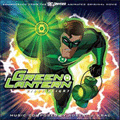
- Robert J. Kral’s kinetic score for Green Lantern: First Flight (La-La Land Records), a score that should give your stereo’s subwoofer a damn fine good workout

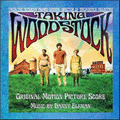
- Taking Woodstock (La-La land Records), Danny Elfman’s venture into retro seventies rock for Ang Lee’s odd little comedy drama


- Rex Steele: Nazi Smasher and Other Short Film Scores (MovieScoreMedia), one of the best composer compilation albums this year. I’ve yet to interview Ryan Shore, but this album proves this composer’s ability to write for any genre. For Jack Ketchum’s Offspring (2009), it was an icy fuzz electronica approach deliberately evoking Cannibal Holocaust, but Rex Steele features a raucous, regal, and moving collection of suites and themes from 7+ short films


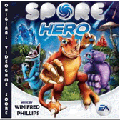
- Spore Hero (EA Games), Winifred Phillips’ latest video game soundtrack. This time it’s for the new Nintendo Wii game, and it’s an hour-long series of lengthy, meaty themes and clever variations. Solid narrative, and another album by a composer to keep watching for (and listening to)


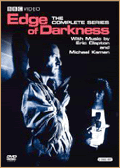
In terms of DVD news, a long while ago I snapped up the Region 2 BBC release of Edge of Darkness (1985), the British mini-series that really gave Martin Campbell his big career break. The series has been remade for American theatrical audiences with Campbell in the director’s chair, and while it’s easy to say this film version slated for 2010 is NOT NECESSARY, perhaps it’ll please audiences hesitant to try out the long mini-series, or have them check it out beforehand (which you should do).

That said, while I’ll have a review of the series up next week (along with Campbell’s early nudie-roughie-silly Brit sexploitation film from the seventies), I will confirm that the Region 1 release out this week is a literally NTSC-PAL conversion of the same Region 2 master, and it includes the same featurettes, vintage interviews and isolated score by Eric Clapton and the late, great Michael Kamen.

Clapton’s forays into film and TV are few, but this was one of his best because of a damned soulful guitar theme which nailed a father’s heartache in losing his daughter, his horror in finding she was pawn in a murderous plot, and trying to make sense of the madness when madness itself is mucking up his own sanity. Big themes nicely delivered in a riveting 3-part mini-series (and a heroine that’s much more sympathetic than the vague, forgettable variation in the film version of The Constant Gardener).

Also new this week is Criterion’s DVD and Blu-ray releases of Wim Wenders’ Wings of Desire (1987), with a new commentary track, and a second disc of extras I’ll have reviewed in time for next week’s 20th anniversary of the Berlin Wall’s demise.

And just because variation is important, coming next are two Tinto Brass features from Cult Epics – Nerosubianco / Attraction (1969), and L’urlo / The Howl (1970) – two films one can regard as the director’s last and very sincere editorial experiments in pop art and political/social/sexual satire before he lost his mind and went popo-crazy.

In 1969, there was the group of European provocateurs Fernando Arrabal, Alejandro Jodorowsky, and DuĊĦan Makavejev… and Tinto Brass, and I’ll explain why, without losing my soul.


- MRH

 
Copyright © mondomark